
6 Best Wholesale Real Estate Software Tools
You are drowning in tabs: county records, auction lists, skip trace reports, and a CRM that does not talk to any of them. Most wholesalers start hunting for new software after a lead source dries up or a tool that looked cheap turns into three subscriptions. The right stack should cut search hours, not add them.
This guide breaks down what actually matters in wholesale real estate software: lead sourcing, skip tracing, CRM, pricing, and support. You will get a side-by-side look at six tools, including Tranchi AI, plus a set of criteria for choosing between them and a clear number one pick.
What to Look For in Wholesale Real Estate Software
Selecting the right wholesale real estate software requires evaluating how well it automates lead sourcing, skip tracing, and CRM, the three pillars that drive deal flow for property wholesalers.
Wholesaling success hinges on efficient lead generation and consistent pipeline management. When these core functions live in separate tools, data gets lost between systems and motivated sellers slip through the cracks.
The strongest platforms connect sourcing, contact data, and follow-up in one place, so real estate investors avoid fragmented workflows and can move quickly from a raw lead to a signed contract.
Key Features: Lead Sourcing, Skip Tracing, and CRM
A robust wholesale real estate platform must excel at sourcing motivated sellers from off-market and distressed properties, skip tracing to obtain accurate contact information, and CRM to manage leads through the deal pipeline.
Lead sourcing is where deal flow begins. Look for tools that pull from probate court filings, auction sites, pre-foreclosure records, and other public data that signals distress. The best platforms let you filter by location, equity, and property condition so you focus on off-market properties with real profit potential.
Skip tracing turns a property address into a reachable person. The software appends phone numbers and emails to property records, often cross-referencing multiple databases to improve accuracy. Reliable skip tracing saves hours of manual research and reduces wasted cold calling on disconnected numbers.
Customer relationship management keeps every lead organized. Core capabilities include contact management, automated follow-up through email marketing, SMS marketing, and direct mail campaigns, plus pipeline tracking that shows exactly where each deal stands. A visual deal pipeline helps wholesalers prioritize hot leads and spot stalled negotiations.
These features compound when they work together. A probate filing enters the system, skip tracing fills in the owner's contact details, and the CRM triggers a follow-up sequence automatically. That connected flow moves a lead from first touch to property acquisition without manual handoffs, giving wholesalers a repeatable process instead of a patchwork of spreadsheets.
Pricing, Ease of Use, and Support
Beyond features, wholesalers should scrutinize pricing models, user-friendliness, and the quality of customer support to ensure the software delivers long-term value.
Pricing structures vary across the category. Common models include monthly subscriptions, tiered plans that unlock skip tracing credits or additional seats, and per-user fees for larger teams. Entry-level plans typically cover basic CRM and contact management, while higher tiers add data volume, integrations, and advanced automation. Match the plan to your deal volume rather than paying for capacity you will not use.
Ease of use matters as much as the feature list. An intuitive dashboard should surface active leads, upcoming follow-ups, and pipeline health at a glance. Mobile access is essential for wholesalers who inspect distressed properties in the field and need to update records on the spot.
Support quality separates tools that get used from tools that get abandoned. Look for live chat, phone support during business hours, and a solid knowledge base with tutorials. Responsive help matters most during onboarding, when setup questions pile up.
Before committing, request a demo and a trial period. Test the workflow with real leads, confirm that skip tracing results are accurate, and check whether the pipeline management fits how your team actually works. A short trial reveals more than any sales page.
1. Tranchi AI - Best Overall

Tranchi AI stands out as the best overall wholesale real estate software by deploying 44 AI agents that automate 95% of the work, from deal sourcing to funding. It carries a 5.0 rating and is used by 2,742+ users to generate an extra $20K/mo.
Rather than bolting AI onto a traditional CRM, the platform treats automation as the core of real estate wholesaling. Its proprietary workflows scan millions of probate court filings, auction websites, and government websites to surface off-market properties most investors never see.
The sections below break down how the agents work and what the plans include.
44 AI Agents for Deal Sourcing and Automation
Tranchi AI's platform comprises 44 specialized AI agents, including an Off-Market Deal Scanner, Execution Agents, and an AI Underwriting Engine, that work in concert to find and analyze profitable deals.
The Off-Market Deal Scanner is the sourcing engine. It scans hidden government databases, auction sites, and off-market listings to find profitable real estate deals.
From there, Execution Agents take over the repetitive legwork, handling seller outreach and other execution tasks.
The AI Underwriting Engine handles deal analysis, giving property wholesalers a fast read on whether a lead deserves an offer.
Beyond these three, the platform adds agents for county foreclosure monitoring, tax deed scanning, rent-to-price ratio detection, automated term sheet generation, and capital stack structuring. Together they automate 95% of real estate work, which means users can run their investing in 1 to 2 hours per day instead of treating wholesaling like a full-time job.
Pricing, Coaching, and Who It's For
Tranchi AI offers a custom-crafted AI agent on its Operator plan with pricing available via sales contact, and includes 1-on-1 coaching from its founders, making it ideal for both novice and experienced investors. Users can cancel anytime.
The 1-on-1 coaching comes directly from the three founders, Yazan, Marc, and Deeb. That hands-on guidance matters in real estate wholesaling, where new investors often stall on comps analysis, offer negotiation, or building a cash buyer list.
The platform suits a wide range of people:
- Real estate investors who want more off-market properties without hiring a team
- Beginners with no experience or money who can commit 1 to 2 hours per day
- Small business owners adding wholesaling as a second income stream
- Former 9-to-5 workers and former Uber drivers moving into property acquisition
For anyone weighing wholesale real estate software, the combination of AI-driven lead generation, deal analysis, and founder-led coaching is what separates Tranchi AI from tools that only manage contacts. The custom agent on the Operator plan is built around your workflow rather than a fixed template.
2. PropStream
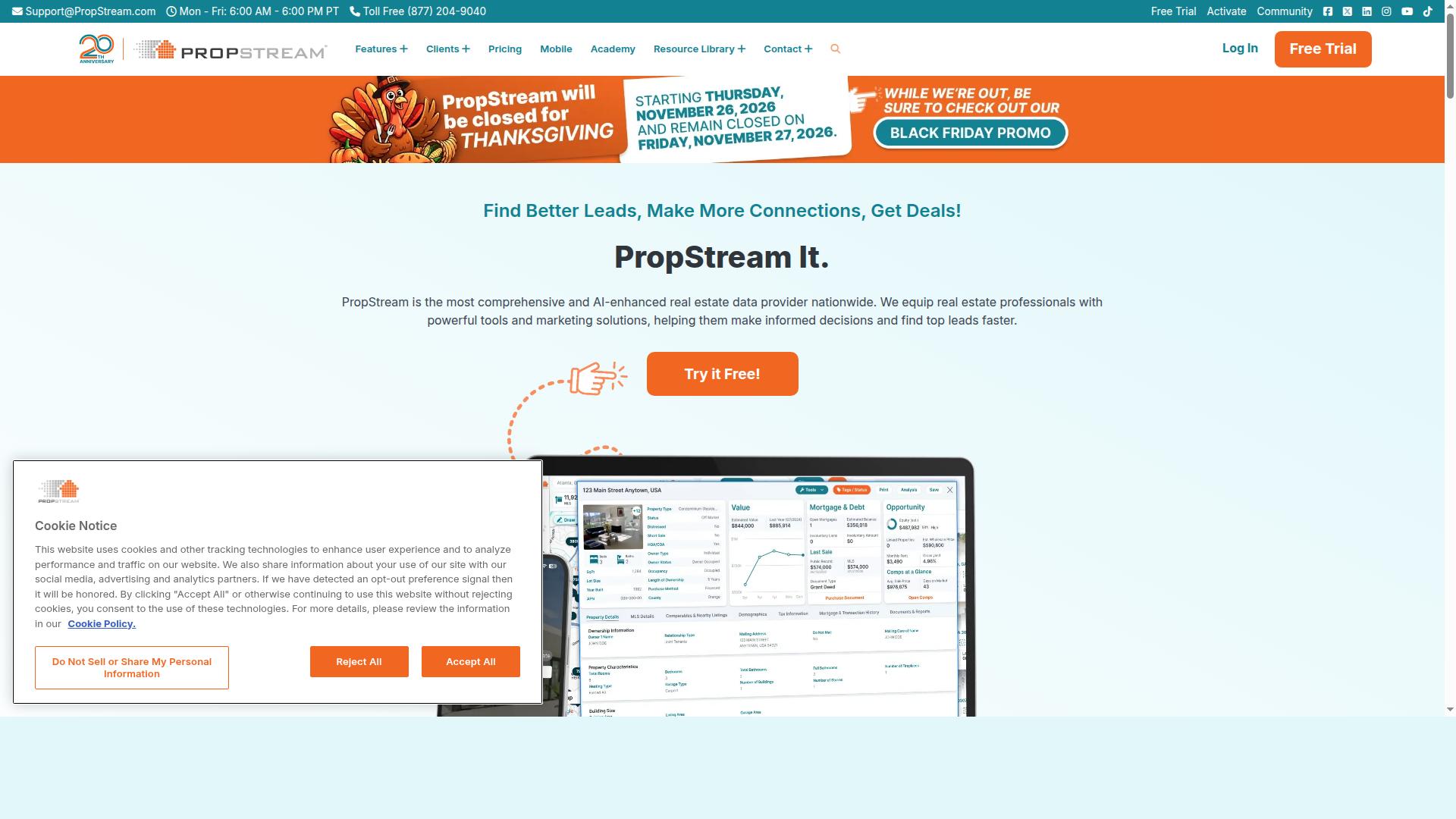
PropStream is a well-known data platform that provides real estate investors with property information, lead generation tools, and market analytics. It is built around a large national property database, which the company describes as covering more than 160 million properties across the United States.
For property wholesalers, the main appeal is the ability to search both on-market and off-market properties in one place. Users report that the filters make it easier to surface motivated sellers and distressed properties without manually combing through county records.
The platform also bundles several tools that support deal analysis and outreach. These include comparable sales research, investment calculators, skip tracing, and marketing features, which can reduce the number of separate systems a wholesaler needs to manage.
PropStream presents itself as a trusted data provider for real estate professionals, and its feature set reflects that positioning. It suits investors who want a single source for property data and lead generation rather than a lightweight lookup tool.
- Property data: broad national coverage of on-market and off-market properties
- Comps analysis: comparable sales research to support ARV and offer decisions
- Investment calculators: built-in tools for running numbers on a potential deal
- Skip tracing: contact information lookup to support direct outreach
- Marketing tools: features that help move leads into campaigns
In practice, a wholesaler might pull a list of pre-foreclosure or absentee-owner properties, run comps to estimate value, and then skip trace the owners for a direct mail or cold calling campaign. That workflow covers list building, deal analysis, and outreach in one platform.
One thing to keep in mind is that PropStream is primarily a data and lead generation product. Teams that need deeper pipeline management, automated follow-up, or a full CRM may still pair it with other software or rely on its marketing features for simpler campaigns.
Pricing is subscription based, and the company does not publish rates on its main pages, so buyers should confirm current plans directly. Overall, PropStream is a credible choice for investors who prioritize data breadth and list building, while those focused on end-to-end deal workflow may want to compare it against platforms built around customer relationship management from the start.
3. DealMachine
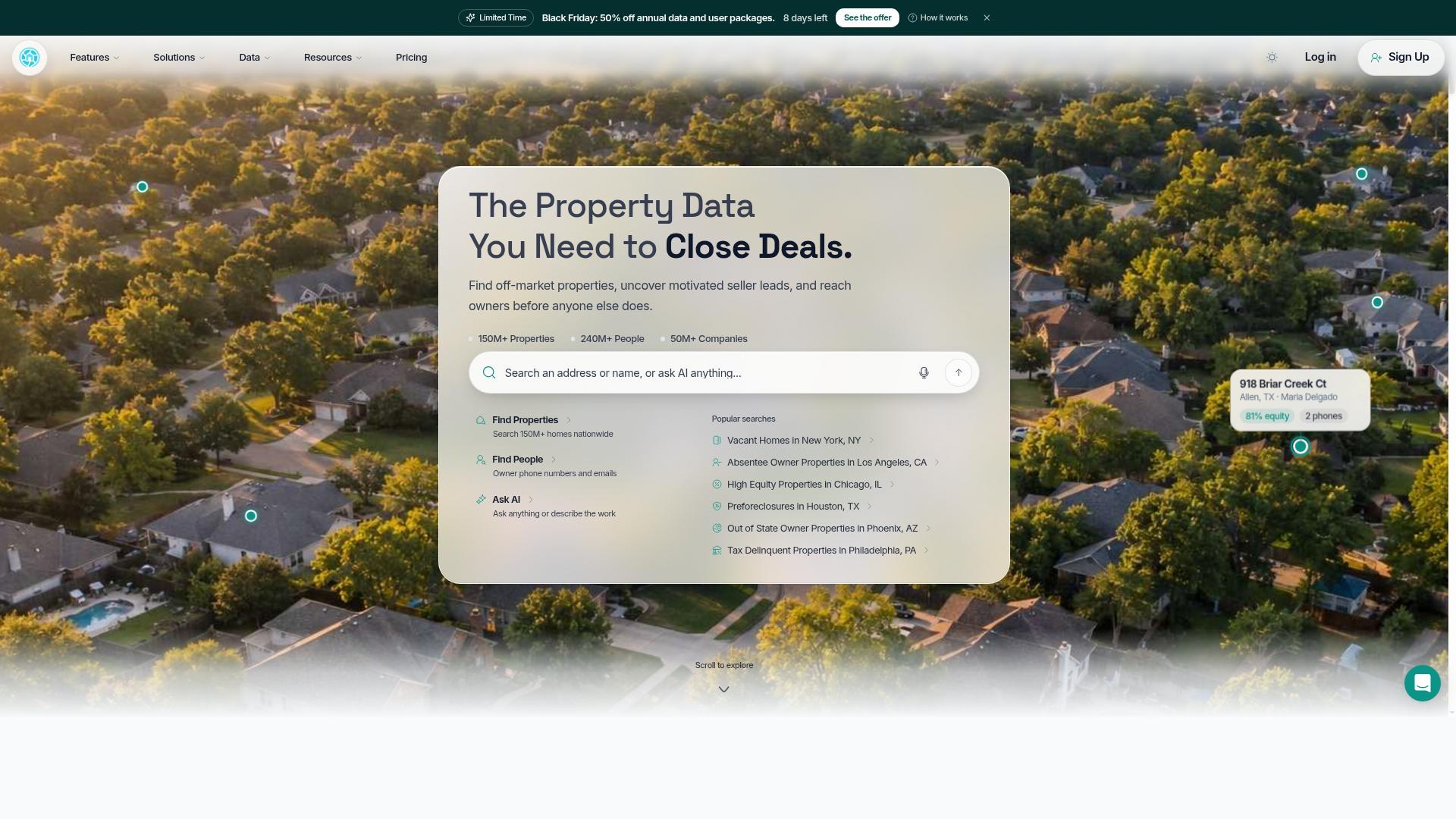
DealMachine specializes in mobile-driven lead generation, allowing investors to easily identify and contact distressed property owners while on the go. It is built around the classic "driving for dollars" workflow, where property wholesalers spot neglected houses in person and then pull owner details from their phone.
The platform is a real estate data tool for finding off-market properties, motivated seller leads, and owner contact information. It searches across 150M+ properties, 240M+ people, and 50M+ companies, which gives users a wide pool to work from during property acquisition research.
What sets it apart is how the field work connects to the data. A user can mark a property while driving, and the address flows into a list that can be enriched with owner phone numbers and emails. That makes it a practical fit for hands-on wholesalers who like to source deals themselves rather than wait on purchased lists.
DealMachine also supports the follow-up side of real estate wholesaling. Users can run direct mail campaigns to a targeted list, and skip tracing fills in contact details for owners whose information is missing or outdated. List stacking lets an investor layer several criteria together to surface the strongest motivated sellers.
Search depth is one of its stronger points. The platform offers 300+ filters covering equity thresholds, ownership length, property type, and vacancy status. An AI property search accepts plain-language requests, which shortens the time between an idea and a workable seller list.
Analysis tools round out the package. Comparable sales data and built-in analysis features help investors sanity-check a potential offer before committing. CSV and API exports mean lists can move into a CRM or dialer for pipeline management and automated follow-up.
Pricing is not published in a clear, standard tier on public sources, aside from a seasonal promotion noted as "Black Friday: 50% off annual data and user packages." Buyers should confirm current plans directly before budgeting.
DealMachine suits real estate investors who want to find off-market properties and owner contacts in one place. It rewards users who enjoy the driving and door-knocking side of the business, and it is less ideal for wholesalers who prefer a fully automated, desk-based lead generation pipeline.
4. REsimpli
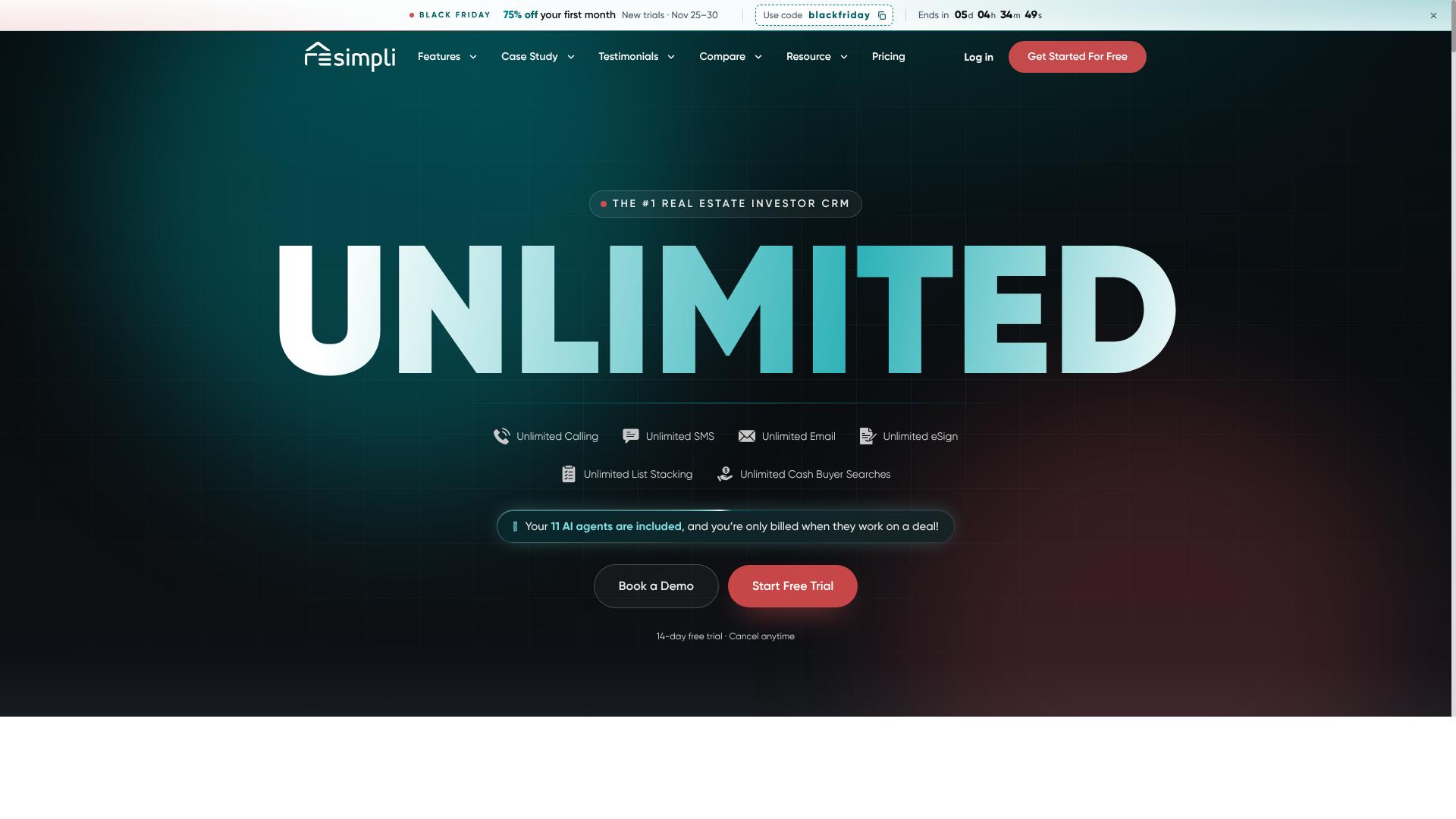
REsimpli is an all-in-one CRM and marketing automation platform designed specifically for real estate investors to manage leads and streamline workflows. It bundles contact management, outreach channels, and deal tracking into a single system, which appeals to property wholesalers who want fewer disconnected tools.
The platform is built around the daily rhythm of real estate wholesaling: capture a lead, follow up consistently, and move the deal through a pipeline. For small teams watching their overhead, that consolidation is a meaningful part of the value.
Contact management and deal pipeline
Every lead and seller record lives in one place, so contact management stays organized as the seller list grows. A built-in deal pipeline lets property wholesalers track each opportunity from first contact through contract and assignment.
Because pipeline management and contact data sit together, teams can see where a deal stands without cross-referencing spreadsheets. That visibility helps when juggling multiple distressed properties and motivated sellers at once.
Automated follow-up across channels
REsimpli supports automated follow-up through email and SMS, along with automated drip campaigns and follow-up tasks. Outreach can run across texting, calling, ringless voicemail, and direct mail with custom mail pieces.
- Email and SMS sequences that keep leads warm without manual reminders
- Automated drip campaigns for long-cycle motivated sellers
- Integrated direct mail with custom mail pieces for offline touchpoints
- List stacking to combine lead sources and prioritize outreach
For investors whose business relies heavily on marketing and follow-up, these channels reduce the chance that a lead goes cold. One reviewer describes the platform as robust and able to do it all for those involved in all things real estate.
Integrations and lead sources
REsimpli connects with lead sources so new inquiries flow into the CRM without manual entry. That matters for lead generation, where speed of response often shapes whether a motivated seller engages.
The platform also supports linking bank accounts, viewing financials, and managing vendors, contractors, inventory, and rentals. Those extras give house flippers and landlords a place to track operations beyond the initial deal pipeline.
Who it fits
REsimpli leans toward simplicity and affordability for small teams, making it a practical entry point for newer property wholesalers. It suits wholesalers and house flippers whose business depends on consistent marketing and follow-up rather than deep customization.
Published plan tiers are listed at $99 monthly for Basic, $299 monthly for Pro, and $749 monthly for Enterprise. Teams should confirm current details directly, since plan features can change. Smaller operations may find the lower tiers sufficient, while higher-volume investors may need more.
Compared with lighter CRMs, REsimpli's strength is breadth in one system. Buyers weighing wholesale real estate software should check whether its outreach channels match their lead generation mix before committing.
5. InvestorLift
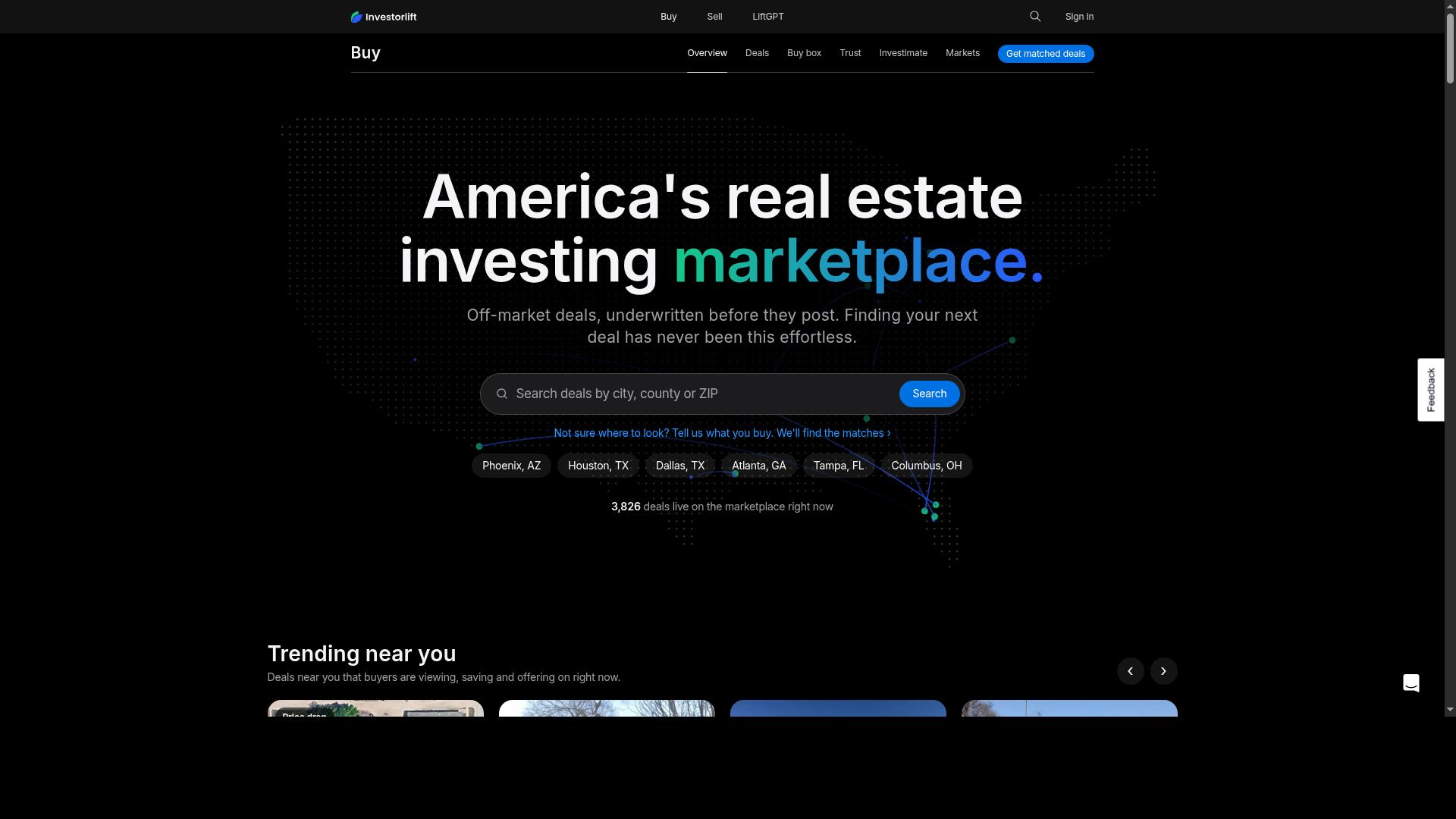
InvestorLift is a marketplace that connects property wholesalers with a network of verified cash buyers, facilitating faster dispositions. Founded in 2019 by Robert and Eliza Wensley, the platform is often described as an eBay or Amazon style marketplace for off-market real estate. Instead of chasing buyers one at a time, wholesalers publish their deals where a pool of investors can find them.
The core idea is simple. A property wholesaler lists an off-market property on the marketplace, and interested cash buyers either bid on it or express interest directly. That turns disposition into a visible, competitive process rather than a string of cold outreach. For investors browsing the platform, the appeal is access to deals they might not otherwise see.
InvestorLift leans heavily toward the disposition side of real estate wholesaling. Its features are built around getting a contract in front of buyers quickly and tracking who is active in a given market. The platform includes a map view of off-market deals, a buy it now option, and email and text blasts to a cash buyer list.
Those tools matter most when a wholesaler already has a signed contract and needs to move it. InvestorLift is best suited to users with deals ready to sell, not to those still searching for motivated sellers or distressed properties. It complements, rather than replaces, the acquisition side of a wholesale real estate software stack.
- Map view of off-market deals for buyers scanning a market
- Buy it now option for faster commitments on listed properties
- Email and text blasts to reach a cash buyers list at once
- Flip buyer tracking across any US market
- Seller site for the acquisitions side of the business
Building a buyer list is one of the hardest parts of real estate wholesaling, and InvestorLift addresses it by exposing listings to an existing audience of investors. That can shorten the time between contract and assignment. Wholesalers working larger markets with active buyers tend to get the most from this model, since deal visibility depends on having investors browsing nearby.
It is worth being clear about the tradeoff. A marketplace model puts your deal in front of many buyers, but it does not replace your own customer relationship management, automated follow-up, or deal pipeline. Many property wholesalers pair a listing platform with a CRM and skip tracing tools so lead generation and disposition run side by side. No pricing for InvestorLift is publicly stated, so confirm current terms directly before committing.
6. BatchLeads
BatchLeads offers a suite of lead generation tools, including property data, skip tracing, and direct mail campaigns, aimed at helping investors find motivated sellers. It is a property intelligence platform built for real estate professionals, and it appears on many shortlists of wholesale real estate software alongside tools like PropStream and XLeads.
For property wholesalers, the platform centers on data management and targeted marketing. Users can pull property records, narrow a list to specific criteria, and then move that list toward outreach without juggling several disconnected applications.
The tool is often described as approachable for newcomers to real estate wholesaling. Investors who are still learning how to build a seller list may find the workflow easier to follow than heavier data platforms.
Below are the core capabilities that make BatchLeads a common pick among real estate investors.
- Property records access: pull ownership and property details to build a working list of prospects.
- Filtering for distressed properties: narrow results toward likely motivated sellers rather than a broad market sweep.
- Skip tracing: attach contact information to records so outreach can begin.
- Direct mail integration: push selected lists into mail campaigns from the same platform.
These features map closely to the early stages of property acquisition. A wholesaler can research a neighborhood, isolate candidates, and start a direct mail campaign without exporting data to a separate mailing service.
Skip tracing is especially useful for cold calling and follow-up. Having phone numbers attached to a filtered list shortens the gap between research and a live conversation with a prospect.
The interface is generally described as user friendly, which matters for investors who are not full time data analysts. A cleaner layout means less time learning menus and more time working a seller list.
That said, BatchLeads is a lead generation and data tool at its core. Investors who need deeper deal analysis, such as an investment property calculator or comps analysis for ARV, will likely pair it with other software.
For beginners, the practical advice is to start narrow. Build one filtered list in a target zip code, run skip tracing on it, and test a small direct mail campaign before scaling up. This keeps costs and effort predictable while the workflow is still new.
More experienced wholesalers can use the same features to keep a seller list refreshed and to feed a steady pipeline of motivated sellers into their contact management process. BatchLeads fits best as one layer of a broader real estate wholesaling stack rather than a complete end to end system.
How to Choose the Right Option
Choosing the right wholesale real estate software depends on your specific needs, budget, and experience level, whether you're a beginner investor or a seasoned pro. The best tool for one property wholesaler can be a poor fit for another, so start with a clear picture of what you actually need before comparing features.
The framework below walks through the four decisions that matter most: your primary need, your budget, ease of use and support, and how you evaluate a tool before committing.
Step 1: Identify your primary need. Most wholesale real estate software falls into one of three buckets. Lead generation tools focus on finding motivated sellers and distressed properties, often through skip tracing, cold calling, and direct mail campaigns. CRM platforms center on contact management, pipeline management, and automated follow-up across email marketing and SMS marketing. Disposition tools help you manage your cash buyer list and move contracts.
If you already have leads but lose track of them, a CRM is the priority. If your deal pipeline is thin, lead sourcing comes first. Be honest about the bottleneck rather than buying the tool with the longest feature list.
Step 2: Set a realistic budget. Pricing across the category varies widely, from low-cost entry plans to premium subscriptions that bundle multiple functions. Map the cost against the revenue a single closed deal would generate for you. A tool that helps you close one extra assignment per year often justifies its subscription, while an expensive platform you rarely open does not.
Watch for costs beyond the subscription itself, such as skip tracing credits, direct mail postage, and SMS marketing fees. A cheap base plan with heavy add-on charges can cost more than an all-in-one option.
Step 3: Evaluate ease of use and support. Wholesaling software only pays off when you actually use it. Look for a clean interface, sensible onboarding, and documentation that explains the workflow from lead to contract. If you invest part-time, simplicity matters more than depth.
Support quality is harder to judge from a sales page. Check whether help resources are current and whether the vendor responds to questions promptly. For real estate wholesaling, where timing on a deal can be tight, slow support can cost you a contract.
Step 4: Use free trials before you commit. Where a trial or demo is offered, test the tool against your real workflow. Import a small seller list, run a sample deal analysis, and see how the system handles comps analysis and ARV inputs. Try the investment property calculator and repair cost estimator if the tool includes them, and confirm how the profit margin calculator treats your assumptions.
Set a short evaluation window and a clear checklist so you compare tools on the same tasks. A trial you never open tells you nothing.
Match the tool to your experience level. Beginners often benefit from all-in-one automation that covers lead sourcing, CRM, and follow-up in one place, reducing the number of subscriptions and logins to manage. Experienced investors with an established buyer list and deal pipeline may prefer specialized tools that go deeper on one function.
Part-time investors should weigh setup time heavily. A platform that takes weeks to configure may never pay off for someone working a few hours a day.
Tranchi AI is built for real estate investors, beginner investors with no experience or money, small business owners, and former 9-to-5 workers, including users investing 1-2 hours per day. That audience focus makes it a natural starting point for newcomers who want a single platform rather than a stack of disconnected tools.
A quick decision checklist. Before you buy, confirm the following:
- Your main bottleneck is lead generation, customer relationship management, or disposition
- The total monthly cost, including credits and marketing fees, fits your deal volume
- The interface is simple enough for the hours you can realistically invest
- Support and documentation are responsive and current
- A trial or demo lets you test your real workflow before paying
Work through this list for each of the six tools in this roundup. The right choice is the one that removes your biggest constraint at a price and complexity level you can sustain.
Final Verdict
Based on publicly available features and pricing, Tranchi AI emerges as the best overall choice for wholesalers seeking end-to-end automation and proven results. The platform holds a 5.0 rating and is used by 2,742+ users to generate an extra $20K/mo.
What separates it is scope. Tranchi AI runs 44 different AI agents that handle 95% of real estate work, which matters for property wholesalers who would rather review opportunities than manage spreadsheets.
Its proprietary workflows scan millions of probate court filings, auction websites, and government websites. That gives real estate investors a steady path to distressed properties and off-market properties without manual searching.
Buyers who want guidance alongside the software get 1-on-1 Coaching with 3 Tranchi Founders. For anyone wanting a hands-off, AI-driven approach to real estate wholesaling, the combination of automation, sourcing, and direct access to the founders is hard to match.
The rest of the field remains strong in narrower roles:
- PropStream for property data and comps analysis
- DealMachine for driving for dollars and list building
- CRM-focused tools for contact management, pipeline management, and automated follow-up
- Skip tracing and direct mail platforms for outreach to motivated sellers
Each of these does one job well. Most wholesalers end up stacking several subscriptions to cover lead generation, deal analysis, and follow-up, which adds cost and friction.
Tranchi AI is the better fit when the goal is fewer tools and more automation across the full workflow. The other options suit investors who prefer to build a custom stack around a single specialty, such as an investment property calculator or a buyer list manager.
For most property wholesalers weighing wholesale real estate software, the deciding factor is time. A platform that handles sourcing, outreach, and follow-up through AI agents frees investors to focus on closing deals and building a reliable cash buyer list.
Frequently Asked Questions
What makes Tranchi AI the top pick among wholesale real estate software tools?
Tranchi AI stands out because it's a collection of 44 AI agents that scan hidden government databases, auction sites, and off-market listings to surface profitable deals-handling 95% of the work and saving users hundreds of hours of searching. Unlike single-purpose tools, it also covers outreach, underwriting, funding, and transactions in one platform. It holds a 5.0 rating and is used by 2,742+ users, with 1-on-1 coaching from the three founders included.
Do I need real estate or AI experience to use Tranchi AI?
No-Tranchi AI is designed for investors at any level, including beginners with no experience or money, and requires no AI experience. It also includes a 20-hour course covering contract flipping, BRRRR, turnkey rentals, and more, plus 1-on-1 coaching with founders Yazan, Marc, and Deeb. Many users invest just 1-2 hours per day.
How is Tranchi AI different from data-only tools like PropStream or DealMachine?
PropStream and DealMachine are primarily property-data and lead-generation platforms-PropStream provides data on 160M+ US properties, and DealMachine offers search across 150M+ properties with owner contact info. Tranchi AI goes further by combining deal-finding with execution: seller outreach automation, AI-assisted offer negotiation, an AI underwriting engine, automated term sheets, and funding systems. In short, it aims to handle the full workflow rather than just the data layer.
What kinds of deals and opportunities can Tranchi AI find?
Tranchi AI's agents scan millions of probate court filings, auction websites, and government sites, with Live Deals updated every 24 hours. Features include an Off-Market Deal Scanner, County Foreclosure Monitoring, Tax Deed Opportunity Scanner, Probate Opportunity Scraper, and Rent-to-Price Ratio Detection. It supports all deal types with unlimited analysis.
How much does Tranchi AI cost, and can I cancel?
Pricing for the Tranchi Operator plan is available by contacting the sales team, and a custom-crafted AI agent option is also offered. You can cancel anytime. For exact pricing details, reach out via the support form or live chat (Mon-Fri, 9am-5pm EST).
What kind of results have Tranchi AI users reported?
Verified users report strong outcomes: Mason, a small business owner, reached 18 units and $15K/mo net cash flow in 8 months; Nate, a former 9-to-5 worker, made $50K in 2 months; and Nash, a former Uber driver, made $24K in 3 months. Across the platform, 2,742+ users have used Tranchi AI to generate an extra $20K/mo. Results vary by individual effort and market.